
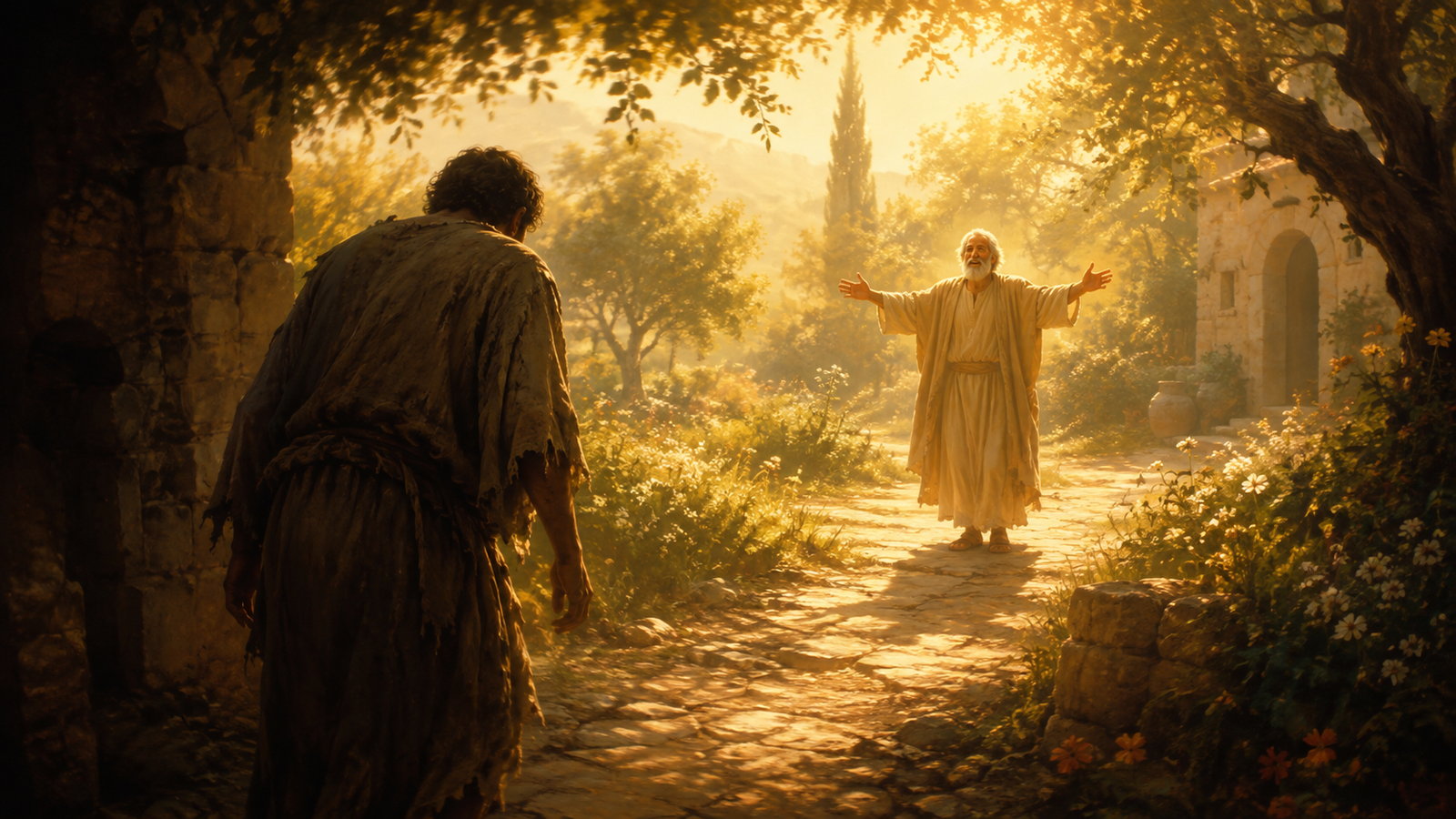
Where Is the Forgiveness? Rethinking the Gospel We Have Been Told
For much of my life, I heard the gospel presented something like this:
Man sinned. God was angry. Sin demanded punishment. The wages of sin were death. Someone had to die. Humanity could not pay the debt, so Jesus stepped in and died in our place. Once Jesus paid the required price, God could forgive us.
I preached versions of that message myself.
But somewhere along my rethinking journey, a question began bothering me:
Where, exactly, is the forgiveness?
If the Debt Was Paid, Was It Forgiven?
Think about it.
If God demanded death as payment for sin, and Jesus paid that debt with His death, then what was forgiven?
God received His payment.
Jesus paid the bill.
The transaction was completed.
But if a debt is paid in full, it isn’t technically forgiven. It was paid.
That distinction has become increasingly important to me.
We often quote Romans 6:23: “The wages of sin is death…” But we sometimes stop before Paul’s sentence gets to the good news: the gift of God is eternal life in Christ. Paul deliberately contrasts wages—something earned—with gift—something given.
What if the gospel is far less transactional than we have made it?
What if forgiveness actually means forgiveness?
Imagine Owing a Million Dollars
Suppose you owed me $1 million.
That is a lot of money to me. I couldn’t pay it.
Maybe some of you could. If so, I’ll send you my P.O. box.
But imagine that you owe someone $1 million and have absolutely no way to repay it.
The person comes to you and says:
“You owe me $1 million. Since you can’t pay it, I’m going to take everything you own. You’ll work for me until the debt is satisfied. I’ll control your possessions, your income, and your future. Eventually, when you die, whatever remains will be canceled.”
Would you call that good news?
Probably not.
Your debt may eventually disappear, but in the meantime, you’ve lost your life.
Now imagine something very different.
The person comes to you and says:
“You owe me $1 million. But I don’t want it back. Your debt is forgiven. No strings attached. You’re free.”
How would that make you feel?
That would be good news.
Not mildly good.
Not “that’s nice” good.
Fall-out-of-your-chair good.
Almost too good to be true.
And I have come to believe that if our gospel never sounds almost too good to be true, perhaps we still haven’t grasped just how good the Good News really is.
The Gospel Became a Get-Out-of-Hell Card
Much of the gospel I encountered in Western evangelical Christianity was essentially about escaping hell and qualifying for heaven.
Believe the right things.
Pray the prayer.
Get saved.
Then someday, after you die, you get the reward.
Of course, we added plenty of strings afterward.
“Now that you’ve prayed this prayer, get into a Bible-believing church.”
“Read your Bible.”
“Pray every day.”
“Start tithing.”
“Go to church.”
“Live right.”
“Stay away from sin.”
And somewhere beneath it all was often an unspoken message:
Don’t mess this up.
I added that last part—but didn’t we sometimes make it feel that way?
The announcement started as “good news,” but before long it became another system of requirements, expectations, performance, and fear.
That’s not overwhelmingly good news.
That’s certainly not Better Than We Thought.
Can God Really Not Look at Sin?
One of the ideas often used to support separation theology is that God is too holy even to look upon sin.
Habakkuk 1:13 is frequently quoted:
“You who are of purer eyes than to see evil and cannot look at wrong…”
But keep reading.
Habakkuk immediately asks God why He does look at the treacherous.
That is the prophet’s entire question: if God’s eyes are too pure for evil, why is God watching wicked people prosper? The verse itself makes it difficult to use the passage as proof that God is literally incapable of looking at sinful people.
And the rest of Scripture gives us an even bigger problem with that interpretation.
God continually comes toward sinful humanity.
He came looking for Adam and Eve.
He interacted with Abraham, Isaac, Jacob, Moses, David, and countless other imperfect people.
And then He did something even more spectacular.
He became one of us.
John tells us that the Word became flesh and dwelt among us (John 1:14). God did not remain far removed from sinful humanity. In Jesus, He stepped right into the middle of it.
Jesus ate with sinners.
Touched the unclean.
Welcomed the rejected.
Defended the condemned.
Walked our roads.
Sat at our tables.
And ultimately submitted Himself to human violence.
That doesn’t look like a God who cannot be around sinners.
It looks like a God who comes looking for them.
Who Hid in the Garden?
Go back to the garden.
After Adam and Eve ate from the tree, who hid?
Adam and Eve did.
Genesis 3 says they heard God walking in the garden, and they hid themselves from Him. Then God called:
“Where are you?”
God showed up for the walk.
Adam didn’t.
Yes, there were consequences to what happened in the garden. Genesis makes that clear. Eventually Adam and Eve were sent from the garden. I am not suggesting sin has no consequences.
I am questioning something different:
Did Adam’s sin change God from a loving Father into an angry God who could no longer stand to be near His children?
The story doesn’t seem to show that.
God still came.
God still called.
God still spoke.
God even clothed them.
What changed dramatically was humanity’s perception.
Before eating from the tree of the knowledge of good and evil, they knew only innocent relationship with God. Afterward came shame, fear, self-consciousness, hiding, and blame.
God asked, “Where are you?”
Adam answered from fear.
That pattern has followed humanity ever since.
Maybe Separation Is Part of Our Delusion
I have increasingly come to believe that sin does something devastating to us—but perhaps not in the way I once thought.
Sin convinces us to hide.
It distorts how we see God.
It creates shame.
It produces fear.
It tells us God doesn’t want us.
It tells us we are unworthy.
It tells us we must somehow find our way back.
And religion frequently gives us elaborate instructions for making the journey.
Try harder.
Do better.
Believe correctly.
Attend more.
Give more.
Pray more.
Perform better.
Maybe then God will be pleased with you.
Maybe then He will come near.
But what if God is already standing in the garden saying:
“Where are you?”
What if God isn’t the one hiding?
What Was the Father Doing at the Cross?
I’ve heard it preached that when darkness covered the earth while Jesus hung on the cross, that darkness represented the moment when the Father turned His face away because Jesus had become sin.
Matthew 27:45–46 certainly tells us that darkness covered the land and records Jesus quoting, “My God, my God, why have you forsaken me?” from Psalm 22.
But the text itself does not say, “At that moment God turned away because He could not look upon sin.”
That interpretation is something we bring to the passage.
Then Paul gives us another picture:
2 Corinthians 5:19 says that God was in Christ reconciling the world to Himself, not counting people’s sins against them.
Don’t rush past that.
God was in Christ.
I no longer see the cross as an angry Father standing at a distance pouring His rage onto His innocent Son.
I see the Father in the Son.
God entered into the very worst humanity could produce—violence, hatred, accusation, religion, empire, betrayal, torture, and death—and revealed that none of it could overcome His love.
Humanity did its worst.
God responded with forgiveness.
“Father, forgive them.”
That looks a lot more like Good News to me.
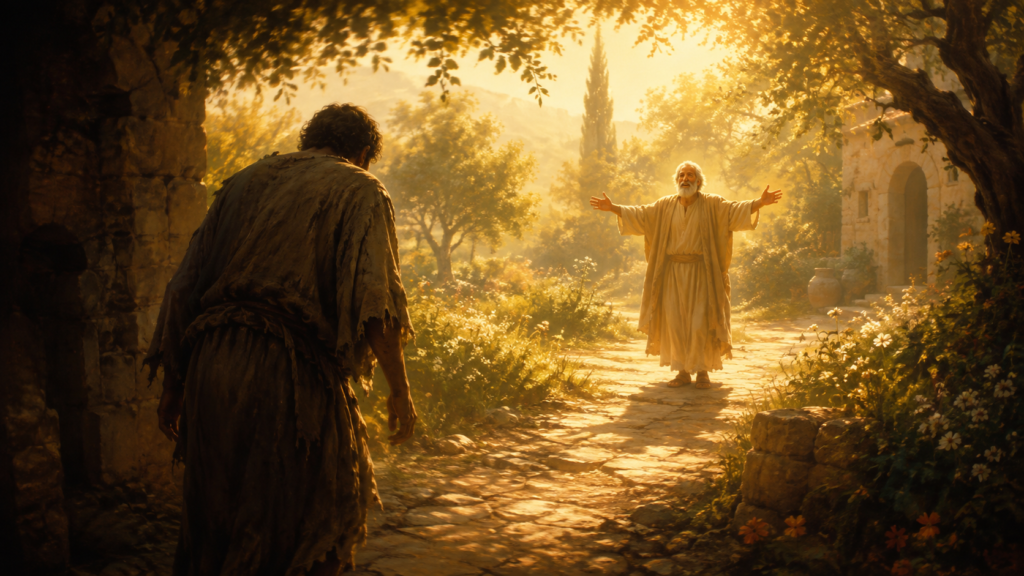
The Prodigal Son Shows Us the Father
Perhaps one of the clearest pictures Jesus gives us of the Father’s heart is the story we call the prodigal son in Luke 15:11–32.
The son destroys his life.
He wastes his inheritance.
He ends up broken, hungry, and ashamed.
Then his thinking changes.
He decides the best he can possibly hope for is to return home as a servant.
Notice the son’s perception of himself:
I am no longer worthy to be called a son.
That is the language of shame.
That is the language of separation.
That is the language of religion.
“I have failed too badly to be a son anymore. Maybe I can earn a place as a servant.”
But the father has an entirely different idea.
Before the son can complete his carefully rehearsed plan, the father runs to him.
He embraces him.
He kisses him.
He calls for the best robe.
He places a ring on his finger.
He restores him to his place in the family.
Then he throws a party.
The son came home expecting servanthood.
The father restored sonship.
The son’s sin had changed how the son saw himself.
It had not changed the father’s heart.
That’s the Father Jesus came to reveal.
The Hot Stove and the Angry Father
Think about your own children.
How many parents have told a child:
“Don’t touch the hot stove.”
That’s a rule.
And the rule exists for a reason.
Now suppose the child touches the stove anyway.
The child disobeyed.
The child gets burned.
There is a consequence.
But what loving parent responds:
“You broke my law. You’re no longer my child. Get out of my house.”
None of us would consider that good parenting.
Instead, we run toward the child.
We comfort them.
We treat the burn.
We may correct them.
We may remind them why the instruction mattered.
But their disobedience did not cause us to stop being their parent.
Why have we imagined our heavenly Father as less loving than that?
Religion Perpetuates the Separation
Religion loves to tell us how bad we are.
Then it offers us a system for getting back to God.
That’s the bait-and-switch I lived with for much of my life.
The message begins:
“God loves you.”
Then somehow becomes:
“Now here is everything you need to do to keep Him happy.”
And I participated in that system.
I preached some of it.
I believed much of it.
Even throughout my own deconstruction—or rethinking, which is still the word I prefer—it has taken years for me to recognize how deeply some of these ideas were embedded in me.
I used to ask:
If this is Good News, why do we always have to begin with such terrible news?
Maybe the reason was uncomfortable:
Perhaps our version of the Good News wasn’t actually as good as we thought it was.
What If It Is Better Than We Thought?
The world sees Christians who talk about freedom while often living under tremendous condemnation.
We worry whether we’ve prayed enough.
Read enough.
Attended enough.
Given enough.
Believed correctly enough.
Repented enough.
Performed well enough.
We fear disappointing God.
We fear punishment.
We fear being separated from Him.
And then we try to convince everyone else how joyful the gospel is.
But what if the gospel actually is joyful?
What if forgiveness really is forgiveness?
What if reconciliation really is reconciliation?
What if the Father has been better than we imagined?
What if Jesus didn’t come to convince an angry Father to love us?
What if Jesus came to reveal the Father who already did?
What if the problem has never been convincing God to come near?
What if the problem has been convincing us to stop hiding?
The Walk Is Still Possible
There is one final image in Scripture that I love.
In the garden, God showed up for the walk.
Adam hid.
Then, generations later, Scripture tells us something remarkable about Enoch:
Enoch walked with God.
Genesis 5:24 says that Enoch walked faithfully with God, and then “he was no more, because God took him away.”
The walk wasn’t gone forever.
And that, to me, is part of the Good News.
Conclusion: Come Out of Hiding
Maybe the gospel isn’t primarily about trying to get an angry God to forgive us.
Maybe it is the announcement that God has always been better than our fear told us He was.
Sin is destructive. It wounds us, distorts us, blinds us, and convinces us to hide. But our hiding does not make God disappear.
He still comes looking.
He still calls.
He still restores.
The Father of the prodigal is still running down the road.
God is still in Christ reconciling.
And the invitation is still there:
Come out of hiding.
The walk is still possible.
Maybe we don’t need to convince God to come near.
Maybe we simply need to discover that He was never as far away as we thought.
And maybe the Good News really is—
better than we thought.